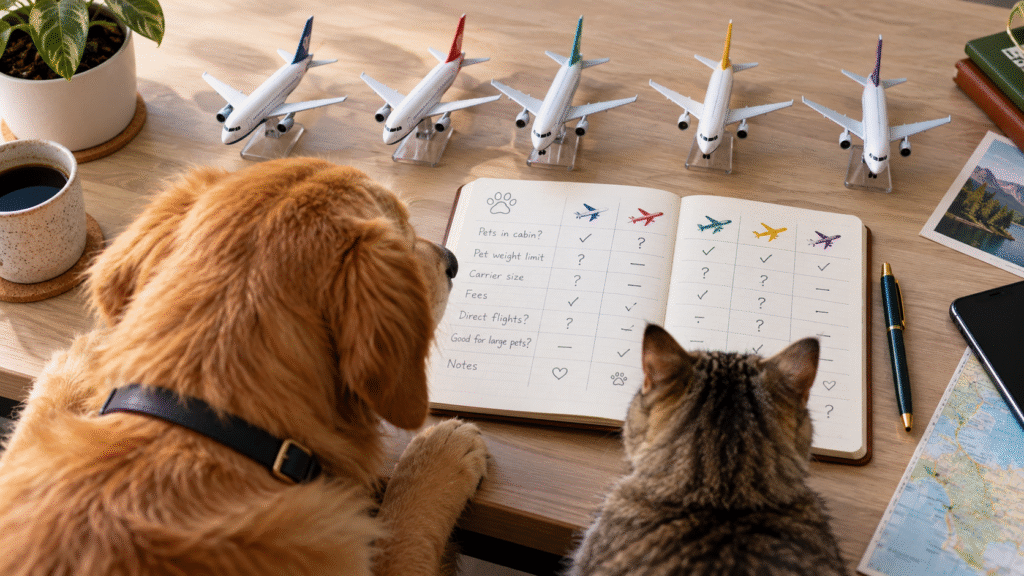
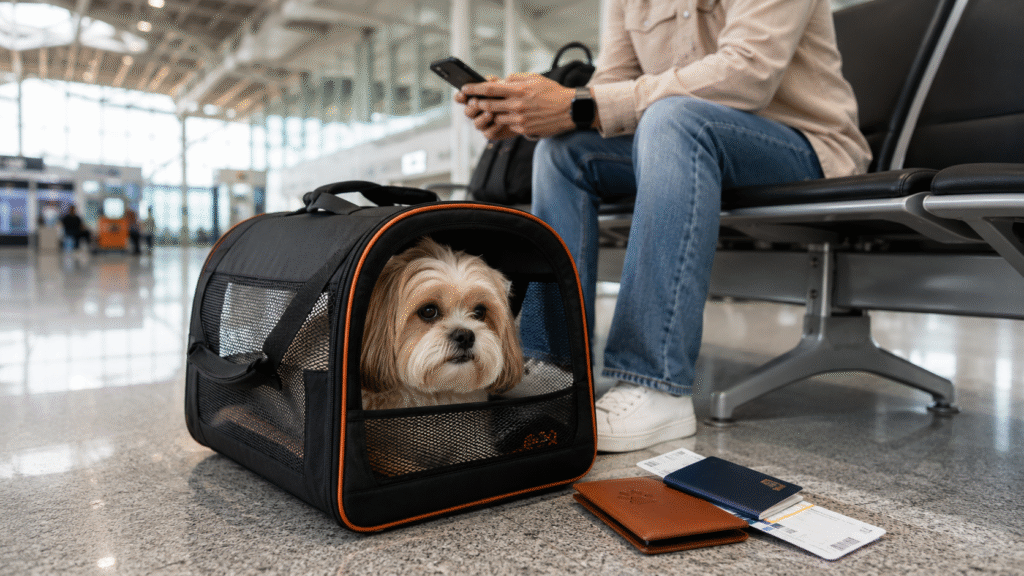
Air India and Akasa Air both allow pets in the cabin, but the similarities mostly end there. Their booking windows, route coverage, age limits, cargo rules, and even their pet-per-flight caps differ enough to change which airline is the better fit for your pet.

If you’re deciding which airline to fly with your pet, the choice in India currently comes down to two real contenders: Air India and Akasa Air.
This guide compares where the two airlines overlap, where they differ, and which is the better fit depending on route, age, weight, breed, and travel requirements.
Which Airlines Fly Pets in India?
Before comparing Air India and Akasa directly, it helps to know where they stand in the wider Indian airline market. Among India’s major scheduled carriers, only Air India and Akasa Air currently allow pets to travel in the cabin.
SpiceJet accepts pets, but only in the cargo hold, not the cabin. IndiGo and Air India Express do not carry regular pets at all, though Air India Express does accommodate service animals.
That narrows the real decision down to these two airlines for anyone who wants their pet close by during the flight.
Air India and Akasa Air: 7 Key Differences for Pet Travel
For comparison at a glance, these are the seven differences most likely to affect which airline you can choose:
- Air India requires pet bookings at least 48 hours before departure; Akasa Air requires 24 hours. See details↓
- Air India accepts pets from 8 weeks of age in the cabin; Akasa Air requires pets to be at least 3 months old. See details↓
- Akasa Air offers domestic-only pet travel, while Air India carries pets on domestic and selected international routes. See details↓
- Akasa Air publishes a maximum cargo weight of 100 kg, while Air India does not publish a fixed upper ceiling. See details↓
- Air India allows one pet per passenger in the cabin; Akasa Air allows up to three pets per flight, including two in the cabin and one in cargo. See details↓
- Cabin seating is handled differently: Air India assigns pet travellers to aisle seats in the last row of Economy, while Akasa Air includes a prebooked window seat. See details↓
- Air India currently publishes a ₹7,500 domestic cabin-pet fee per sector, while Akasa’s pet charges vary by weight and travel mode. See details↓
Quick Comparison: Air India vs Akasa Air
| Category | Air India | Akasa Air |
|---|---|---|
| Cabin weight limit | Up to 10 kg (pet + carrier) | Up to 10 kg (pet + carrier) |
| Checked baggage/hold limit | 10–32 kg | 10–32 kg |
| Cargo limit | Above 32 kg (no published upper cap) | 32–100 kg |
| Max pets per flight (cabin) | 1 pet per passenger; maximum 2 pets in the cabin per flight | 2 |
| Max pets per flight (total) | Not separately capped beyond cabin limit | 3 (2 cabin + 1 cargo) |
| Minimum booking window | 48 hours before departure | 24 hours before departure |
| Reporting time at airport | 3 hours before departure | Not separately specified; standard early arrival advised |
| Minimum pet age (cabin) | 8 weeks | 3 months |
| Minimum pet age (hold/cargo) | 3 months | 3 months |
| Route coverage | Domestic and international (with country restrictions) | Domestic only |
| Snub-nosed breeds in cargo | Not permitted | Restricted, treated with added caution |
Cabin Travel: Nearly Identical on Air India and Akasa Air

This is where the two airlines line up most closely. Both currently cap cabin travel at 10 kg combined weight for the pet and its carrier. Akasa raised its cabin limit from 7 kg to 10 kg in 2024, while Air India has also increased its cabin allowance from an earlier lower limit.
Carrier specifications are broadly similar too. Both airlines expect a soft-sided, ventilated, leak-proof carrier that fits under the seat and allows your pet to stand, turn, and lie down. Exact dimension limits vary slightly between the two, so double-check your specific carrier against whichever airline you book. A carrier accepted by one airline may not meet the other airline’s size requirements.
Where they start to differ is in the small print. Air India requires pets to be at least 8 weeks old for cabin travel, while Akasa sets the bar slightly higher at 3 months. If you’re flying with a very young puppy or kitten, that difference alone may determine which airline is an option.
Cabin seating arrangements differ noticeably between the two airlines. Air India generally assigns passengers travelling with pets to designated seats toward the rear of the cabin, with specific spacing rules if two pets are onboard. Akasa, by contrast, includes a prebooked window seat as part of its pet-travel service. For pet parents, that may make Akasa’s cabin experience more comfortable.
Akasa also includes a few complimentary pet-travel conveniences with its cabin service; besides a prebooked window seat, it offers priority check-in & baggage handling, and priority boarding. These do not change the pet rules themselves, but they can make a huge difference when you are travelling with an animal.
Related article: How to Crate-Train Your Pet Before Travelling
Pets Over 10 kg: How Air India and Akasa Air Handle Larger Pets

For pets between roughly 10 kg and 32 kg, both airlines route them through checked baggage in the cargo hold rather than the cabin. The weight bracket itself is essentially identical between the two carriers.
The real difference shows up above 32 kg. Akasa Air clearly publishes a cargo ceiling of 100 kg, giving pet parents with larger dogs a defined upper limit to plan around. Air India’s published guidance doesn’t specify a hard upper cap in the same way. Larger pets are handled through its cargo/freight process under the AVIH (Animal in Hold) classification on a more case-by-case basis.
If you’re travelling with a genuinely large breed, Akasa’s clearer published limit may make planning slightly more predictable. However, confirm your exact pet’s eligibility directly with either airline before booking.
You can read more about Akasa Air pet policy here: Akasa Air Pet Policy: Cabin, Check-In and Cargo Rules
Number of Pets Allowed: Air India and Akasa Air Use Different Limits
The two airlines do not describe pet limits in exactly the same way. Air India allows one pet per passenger in the cabin, with a maximum of two pets travelling in the passenger cabin on a flight. If two pets are accepted on the same flight, Air India also applies seating-separation rules between the passengers travelling with them. Akasa Air allows a maximum of three pets on a flight in total: up to two pets in the cabin and one pet through cargo.
Both Air India and Akasa Air limit the number of pets per flight, so booking early is important, particularly if more than one passenger on the flight is travelling with a pet.
If you are travelling with multiple pets, the important question is not only whether the airline accepts pets, but how many can travel on that particular flight and in which mode. Confirm availability for every pet before finalising your own ticket.
Related guide: Air India Pet Policy
Booking Windows: Akasa Is More Forgiving
If your travel plans come together quickly, this difference can matter more than it might seem. Akasa Air only requires pet bookings to be confirmed 24 hours before departure. Air India requires 48 hours. That extra day of lead time with Air India can make a real difference for same-week or short-notice travel.
For both airlines, the booking window is not a formality. Both use it to complete document verification and confirm pet slot availability, since cabin space for pets is limited per flight regardless of which airline you choose.
Route Coverage: This Is the Real Deciding Factor for Many Trips
Here’s where the two airlines genuinely part ways, and where your own itinerary will likely decide for you regardless of any other comparison.
Akasa Air’s pet service is domestic-only. If your trip is entirely within India, this limitation won’t affect you at all. But if you need to fly your pet internationally, Akasa isn’t an option right now.
Air India carries pets on both domestic and international routes, though international travel comes with a few restrictions. Air India does not carry pets, cabin or otherwise, on flights to or from the United States, Canada, or Australia. For the United Kingdom, pets may travel only as cargo on eligible London Heathrow or Gatwick routes. For the UAE, pets may travel in the cabin on flights departing the UAE where destination rules permit, but they are not permitted in the cabin on flights from India to the UAE.
International connecting journeys with pets must also remain within Air India’s own network, since pet bookings are accepted only when the connecting flights are Air India-operated.
In short: for a purely domestic trip, both airlines are genuine options. For anything international, Air India is currently the only one of the two offering a path at all, and even then, only on routes it hasn’t specifically excluded.
Snub-Nosed and Flat-Faced Breeds: Air India Draws a Firmer Line

If you own a pug, a bulldog, a Persian cat, or another brachycephalic breed, pay close attention to this distinction.
Air India’s policy explicitly prohibits flat-faced breeds from the cargo hold entirely, citing their heightened risk of respiratory distress and temperature sensitivity. Cabin travel remains an option for these breeds on Air India, generally alongside a recommendation to get veterinary clearance beforehand.
Akasa Air similarly treats snub-nosed breeds with added caution and restriction, particularly outside the cabin. Its pet indemnity form specifically refers to brachycephalic pets and requires owners to acknowledge the risks involved in their carriage. If your flat-faced pet exceeds the cabin weight limit, confirm directly with Akasa whether your specific breed, route, and travel conditions are accepted before booking.
For flat-faced pets, the practical takeaway is simple: cabin travel is generally the preferable option when your pet meets the cabin requirements.
For more information on travelling with flat faced breeds read: Can Persian Cats Fly on Air India?
Fees and Costs
Both airlines charge separately for pet travel, and the pet fee is not included in your normal baggage allowance.
Air India currently charges ₹7,500 per sector for pets travelling in the cabin on domestic flights. Charges for pets travelling as checked baggage, in the hold, or through cargo can vary depending on weight, route, and travel mode, so confirm the exact amount before booking.
Akasa similarly charges based on weight and travel mode rather than a flat universal rate. Because pricing structures shift and vary by sector, it’s worth getting a direct quote from your airline of choice at the time of booking rather than relying on a fixed number from any guide.
Documentation: Broadly Similar Requirements

Both airlines require the same core paperwork: an up-to-date vaccination record, a veterinary health certificate confirming your pet is fit to travel, and a signed indemnity form acknowledging the airline’s terms for pet carriage.
Air India currently requires the health and rabies vaccination certificate to be signed and stamped by a registered veterinarian, with the health certificate issued within 7 days before departure or according to the rules of the destination state or country. Original documents are verified at airport check-in.
Akasa similarly requires current vaccination and health documentation and a completed indemnity form. Its indemnity form states that the pet must be up to date on vaccinations, including rabies where applicable, and accompanied by the latest health and vaccination certificates.
For domestic travel, the documentation burden is broadly similar between the two airlines. The bigger difference comes if you’re flying Air India internationally, where destination-country import rules and Animal Quarantine and Certification Service (AQCS) clearance add real complexity that domestic Akasa bookings simply don’t involve.
Also read: Documents Required for Pet Travel in India
Which Airline Should You Choose?
There’s no single right answer here; it completely depends on your trip.
Choose Akasa Air if: your trip is entirely domestic, you’re working with a shorter booking timeline, your pet is on the larger side, and you want a clearly published cargo weight ceiling to plan around, or you want the slightly more forgiving 24-hour booking window.
Choose Air India if: your trip involves international travel (and your destination isn’t one of Air India’s excluded countries), you have a very young puppy or kitten just over 8 weeks old that wouldn’t yet qualify for Akasa’s 3-month cabin minimum, or you specifically need Air India’s option of AVIH cargo handling for a very large pet without Akasa’s 100 kg ceiling applying.
For flat-faced or brachycephalic pets specifically, cabin travel is realistically your best option on either airline, with a veterinary check beforehand strongly advised regardless of which carrier you choose.
For pets above cabin weight limits, compare the exact aircraft, route, crate weight, and current cargo/hold acceptance directly with both airlines before choosing.
Final Thoughts
Air India and Akasa Air both offer genuine cabin access for pets, which most airlines in the country still don’t. But the differences aren’t cosmetic: booking windows, minimum pet age, international route coverage, cargo limits, seating arrangements, and pet-service features can each influence which airline is better for your particular journey.
Note: Airline pet policies are updated periodically. Always confirm current weight limits, fees, booking windows, and route restrictions directly with Air India or Akasa Air before booking travel with your pet.
Image Disclaimer: Some images used in this article are AI-generated or digitally created for illustration purposes. They are intended to explain pet air-travel situations and may not show exact airport areas, aircraft cabins, airline seating, pet carriers, cargo facilities, or actual Air India and Akasa Air arrangements. Always check the airlines’ official pet policies, carrier requirements, seating rules, charges, and travel conditions directly before booking or travelling.