A dog car seat belt, safety harness, and travel crate can all keep a dog from moving freely around the car, but they do not offer the same type of restraint. The safest choice depends on how well it fits, how secure it is, and whether it has been properly tested for vehicle travel.
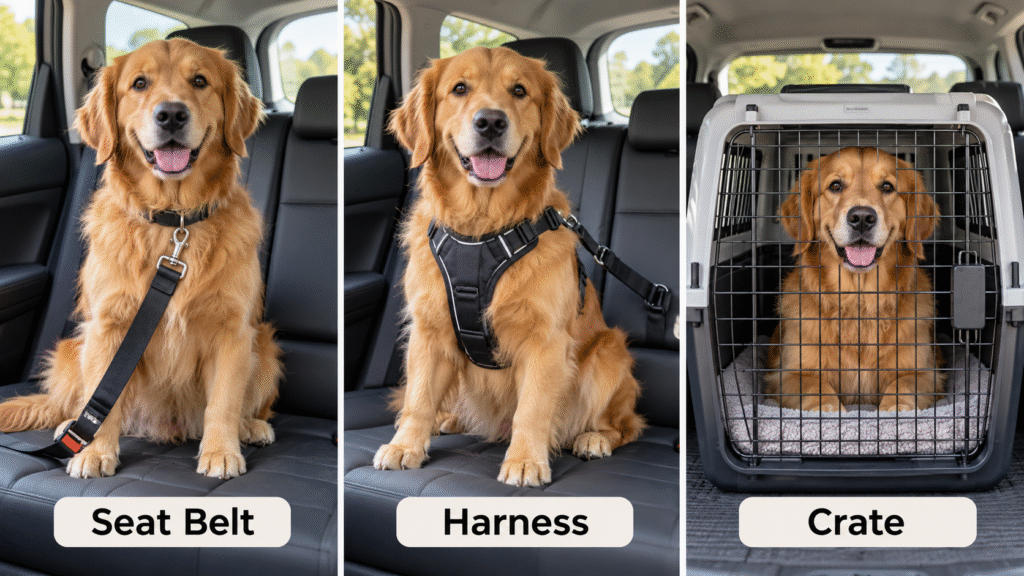
When comparing a dog car seat belt vs harness vs crate, it is easy to assume that anything designed to keep your dog in one place is doing roughly the same job. It isn’t.
A simple tether may stop your dog from climbing onto the driver’s lap. A car safety harness is designed to restrain the dog’s body. A secured travel crate contains the dog within a separate structure.
All three can change how safely your dog travels; therefore, fit, construction, attachment points, available movement, crash testing, and correct installation all matter.
Here is how the three options differ and what to consider before choosing one for your dog.
1. What Is a Dog Car Seat Belt?
Products sold as dog seat belts are usually short tethers that connect your dog to the vehicle through a seat-belt buckle, seat-belt system, or another attachment point.
They are popular because they are inexpensive, easy to carry, and quick to attach.
They can also stop a dog from roaming around the vehicle, climbing into the front seat, or distracting the driver.
But the tether is only one part of the restraint system.
Never Attach a Car Tether to a Collar:
A car tether should be attached to an appropriate harness rather than your dog’s neck collar. During sudden braking, the restraint can tighten abruptly. Concentrating that force around the neck is very different from distributing it across a properly designed harness.
The length of the tether matters too. Giving your dog enough length to walk around much of the back seat may feel comfortable, but excessive movement can also mean greater movement during a sudden stop.
A seat-belt tether is therefore better as a connection device, not as a complete car-safety system.
2. What Is a Dog Car Safety Harness?
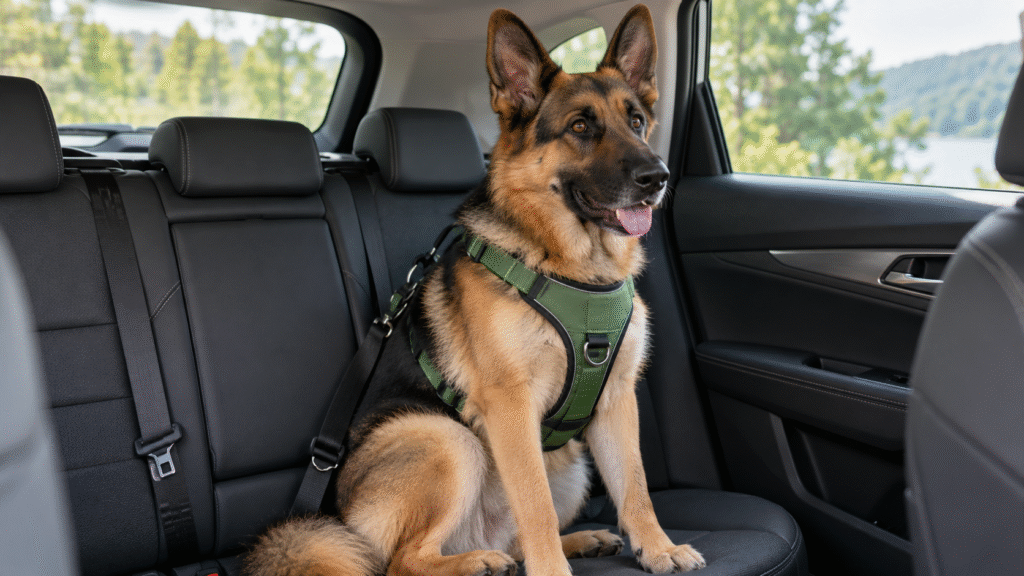
A car safety harness is worn around the dog’s torso and connects the dog to the vehicle restraint system. Unlike a collar, a properly designed harness spreads restraint across a larger part of the body.
However, not every harness is designed for car travel. A comfortable walking harness may be excellent for everyday walks but may never have been designed or tested to manage the forces involved in a collision.
When choosing a harness for vehicle travel, look beyond phrases such as car harness, safety harness, or crash-tested on the packaging. Check how the product was tested, what sizes were tested, how it attaches to the vehicle, and whether the manufacturer provides clear installation instructions.
Independent organisations such as the Center for Pet Safety test and certify certain pet travel harnesses, carriers, and crates.
A Car Harness May Suit Your Dog If:
- Your dog dislikes travelling inside a crate
- Your vehicle does not have enough space for an appropriately sized crate
- You take frequent car journeys
- Your dog is comfortable sitting or lying on the back seat
- You want a restraint that can be used without lifting a crate in and out of the vehicle
The harness should fit snugly without restricting normal breathing or comfortable positioning.
3. What Is a Travel Crate for Car Use?
A travel crate provides a separate enclosed space for your dog rather than restraining the dog directly to the seat. For dogs already comfortable with crate travel, this can offer both containment and a familiar place to settle. It also prevents a dog from wandering through the vehicle or interfering with the driver.
But putting a crate in the back of the car does not automatically make it a safe setup. The crate itself needs to be suitable for vehicle travel, and it needs to remain securely positioned.
An unsecured crate can move during hard braking or a collision. The combined weight of the dog and crate also places substantial force on whatever is holding the crate in position.
Check the manufacturer’s installation instructions and your vehicle’s available anchor points rather than improvising with weak straps or luggage hooks.
Not sure which type of carrier or crate will suit your journey? See our guide to Dog Travel Carrier: How to Choose the Right One for Car, Train, and Flight before buying or packing one.
A Crate May Suit Your Dog If:
- Your dog is already comfortably crate-trained
- You have sufficient space in your vehicle
- Your dog becomes restless when travelling on a seat
- You regularly take longer road trips
- You want your dog contained when car doors are opened during stops
Never force an anxious, untrained dog into a crate for their first long road journey. Crate familiarity should begin before the trip.
Related read: How to Crate-Train Your Pet Before Travelling.
4. Seat-Belt Tether vs Harness: Why the Difference Matters
These two terms are often used interchangeably, which makes buying car equipment unnecessarily confusing. Think of them as two different parts:
Harness: worn by the dog and distributes restraint across the body.
Tether: connects the harness to the vehicle.
Some car harness systems connect directly to the vehicle’s seat belt without requiring a separate tether. Others use their own connection system. This is also why buying a cheap tether and clipping it onto an ordinary collar does not turn it into a car safety harness.
Long extension tethers and zipline-style systems also allow considerably more movement inside the vehicle. More freedom may seem attractive, but restraint equipment is supposed to control movement when something goes wrong, not just keep the dog in the back half of the car.
5. When a Car Harness Makes More Sense
A car harness is often the more practical choice when you have limited vehicle space or a dog that is uncomfortable inside a crate. It can work particularly well for:
- Frequent everyday drives
- Medium or large dogs when a suitable crate would occupy most of the cargo space
- Dogs accustomed to settling on the back seat
- Vehicles without a suitable location for securing a travel crate
A harness also makes getting in and out during rest stops relatively straightforward.
However, loose straps, incorrect routing, or attaching the restraint differently from the manufacturer’s instructions can undermine the system you carefully bought.
6. When a Travel Crate Makes More Sense
A secured crate can be particularly useful for a dog that already treats their crate as a familiar resting space. It may also be preferable when:
- Your dog becomes highly excited by passing traffic
- Your dog repeatedly tries to move around the car
- Opening car doors during stops creates an escape risk
- Your vehicle has sufficient room for a suitable crate
- You regularly travel long distances
Crate size matters as well. Your dog needs enough room to occupy the crate comfortably, but simply choosing the largest crate that fits your vehicle is not necessarily the answer. Follow the manufacturer’s sizing and installation guidance for the specific product.
7. Common Dog Car-Restraint Mistakes
Even good equipment can become a poor safety setup when it is used incorrectly.
- Attaching the tether to a collar: Use an appropriate harness rather than putting sudden restraint force around your dog’s neck.
- Assuming every harness is a car harness: Walking harnesses and vehicle safety harnesses are designed for different jobs. Check the intended use before relying on one for car restraint.
- Giving the dog too much tether length: A tether that allows your dog to wander around the entire rear seat defeats much of the purpose of restraining movement.
- Leaving a crate unsecured: A crate should not simply be placed in the cargo area and assumed to be secure because it is heavy.
- Trusting the words “crash tested” without checking further: Look for information about who conducted the test, the test protocol used, the sizes tested, and the results rather than relying on the phrase alone.
- Allowing the dog to ride in the front passenger seat: Airbags designed to protect human passengers can create additional danger for a dog in the front seat.
- Allowing the dog to roam freely: An unrestrained dog can distract the driver, move into the footwell, escape when a door opens, or be thrown inside the vehicle during sudden braking.
For more general guidance on keeping pets safe in vehicles, see the AVMA’s advice on pets in vehicles.
8. How to Choose the Right Setup for Your Dog
Start with your dog rather than the product. Consider:
- your dog’s size and weight
- whether they are comfortable in a crate
- their behaviour in the car
- how much space your vehicle has
- where the restraint or crate will be positioned
- how the equipment connects to the vehicle
- whether independent safety-testing information is available
- how often and how far you usually travel
If your dog is anxious in the car, changing restraint equipment alone may not solve the problem. Introduce the setup gradually and let your dog become comfortable with it before expecting them to spend several hours travelling. And whichever system you choose, use it on ordinary short drives too. Restraint is not only for road trips.
Dog Car Seat Belt vs Harness vs Crate: Which is Safer?
There is no useful safety ranking based on the labels alone. A poorly secured crate is not automatically safer than a properly fitted, independently tested car harness, and a basic tether should not be assumed to provide the same protection as a complete restraint system.
For most dogs, the stronger starting point is either a properly fitted, independently tested car safety harness or an appropriately sized, tested travel crate that is correctly secured inside the vehicle.
The better question is not simply, “Which one should I buy?” but “How will this system restrain my dog if the car stops suddenly?”
Image Disclaimer: Images used in this article are AI-generated or digitally created for illustration purposes.